
Elevator Door Safety Sensors: What They Prevent

A passenger entering a lift car should not have to judge whether the doors will reopen in time. Elevator door safety sensors are the protective devices intended to detect a person, wheelchair, trolley, or object in the doorway and command the doors to stop or reopen. When they are correctly specified, adjusted, and maintained, they reduce one of the most immediate risks in everyday lift operation: contact with closing doors.
For building owners and facilities teams, door protection is not a cosmetic upgrade. It is a safety-critical part of the lift system that affects passenger confidence, service calls, downtime, and the long-term condition of door equipment. A sensor that no longer detects reliably can create nuisance reversals at first, then become a more serious exposure if left unresolved.
How elevator door safety sensors work
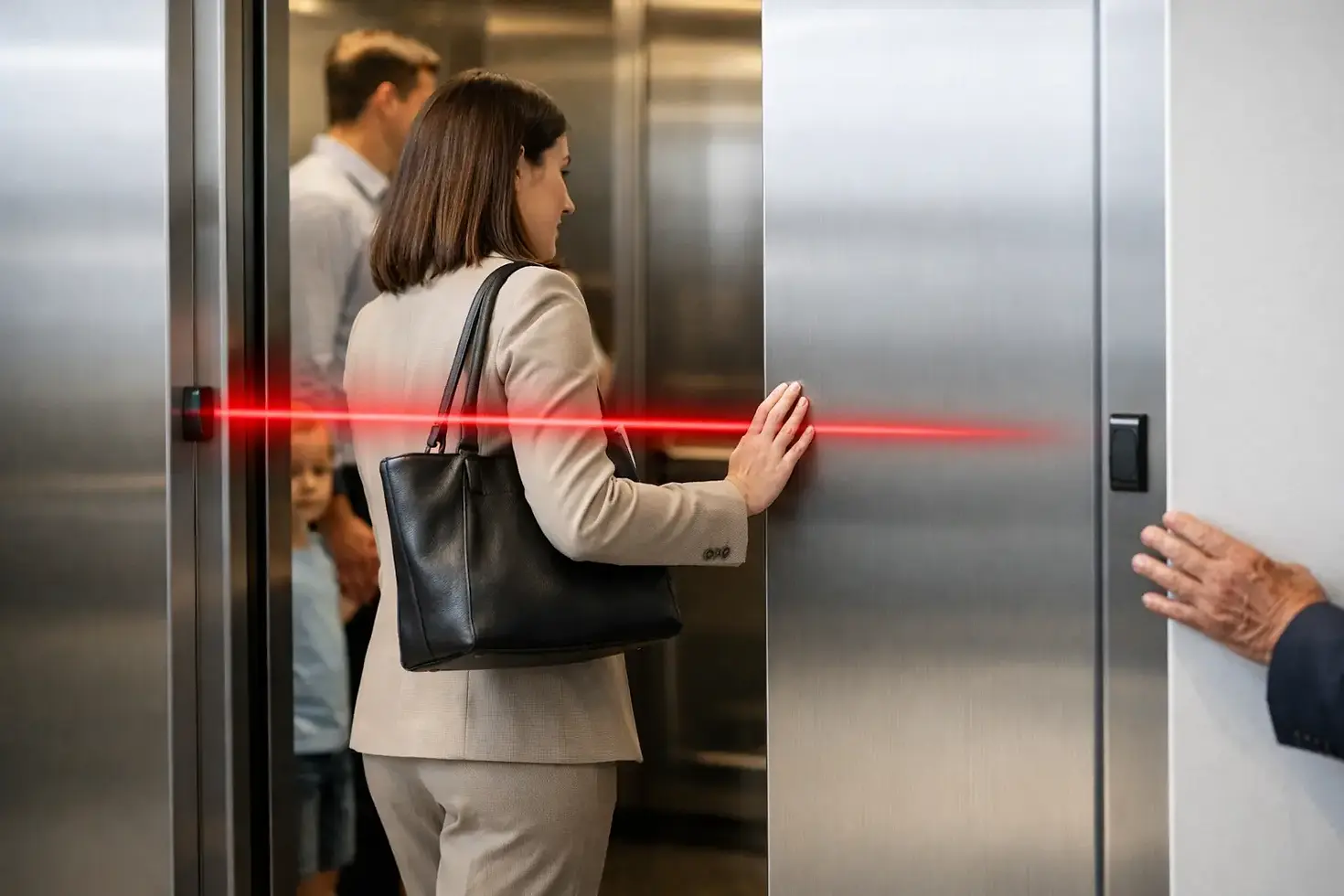
Most modern passenger lifts use an infrared light curtain installed along one or both door edges. The curtain creates multiple invisible beams across the entrance. If a passenger or object interrupts one or more beams while the doors are closing, the door operator receives a signal to reverse or hold the doors open.
This arrangement provides protection across much of the doorway height, rather than at one fixed point. That matters for children, walking aids, delivery carts, and low or narrow objects that may not be detected by older single-beam systems.
Some installations also use a mechanical safety edge or a door-edge contact. This device reacts after physical contact with an obstruction, causing the doors to reopen. It remains a useful secondary protective measure, but it is not equivalent to a properly operating light curtain. Contact-based protection responds later in the closing cycle and can be less suitable where passenger traffic is heavy or where vulnerable users are expected.
Door protection must also be considered alongside the door operator's force settings, closing speed, car door tracks, rollers, and landing door locks. A light curtain cannot compensate for badly adjusted door gear. Likewise, a correctly adjusted operator cannot make up for a failed or obstructed detector.
Why door sensors fail before the lift stops working
Door sensor faults are not always obvious. A lift may continue to run while its doors repeatedly reopen, close too slowly, or fail to respond consistently to an object in the entrance. These symptoms are often treated as minor inconvenience, but they should trigger inspection.
Infrared light curtains operate in a demanding location. Door panels move repeatedly, passengers strike or lean against the entrances, cleaning chemicals and dust accumulate, and wiring is subject to constant flexing. In Singapore's humid environment, contamination and corrosion at connectors can also affect signal quality over time.
Common causes include dirty or damaged sensor lenses, misaligned transmitter and receiver strips, loose traveling cables, worn door rollers, damaged mounting brackets, and failed control-board inputs. A poorly fitted door skin or damaged sill can also alter door movement enough to create intermittent faults.
The trade-off is clear: a highly sensitive detector may respond to small obstructions but can produce repeated nuisance reversals if it is misaligned or affected by environmental conditions. Reducing sensitivity simply to stop callbacks is not a sound corrective action. The underlying cause should be identified, then the sensor and door operator should be tested together under normal operating conditions.
The difference between nuisance reopening and a safety defect
Repeated door reopening is not automatically proof that a light curtain has failed. A passenger standing in the detection zone, an item projecting through the doorway, or an uneven door movement can all trigger a reversal. However, patterns matter.
A lift that reopens at the same floor, at the same point in the closing cycle, or during certain weather conditions may have a localized issue. If the doors close normally when empty but reverse with a trolley or wheelchair entering, the light curtain may be responding correctly. If a visible object is not detected at all, the condition requires prompt attention.
Facilities personnel should record the lift number, floor, time, operating condition, and any observed door behavior before requesting service. This gives the technician useful fault context, particularly where the issue is intermittent. It also helps distinguish a door protection fault from problems involving the landing door lock, car door clutch, or door operator.
Inspection should cover the complete doorway system
A proper maintenance visit should not treat the detector as an isolated component. The technician should examine its physical condition, clean the sensing surfaces using suitable materials, check alignment and mounting security, and verify cable condition. Functional tests should confirm that the doors reverse or remain open when the detection field is interrupted during closure.
The door system itself also requires attention. Door tracks and sills should be free of debris. Hangers, rollers, guides, couplers, belts, and linkages should move correctly. Door closing force and speed must be set within the applicable requirements for the equipment and site. Landing doors must lock and release correctly, because door safety is dependent on both passenger protection and secure shaft access.
For managed properties, these checks should form part of planned preventive maintenance rather than a response after an incident. Maintenance records should identify replaced components, recurring door faults, adjustments made, and tests completed. This is particularly useful for older installations where replacement parts may have changed across previous repair visits.
When modernization is the better option
Older lifts may rely on limited-area infrared detectors, mechanical safety edges, or discontinued components that are increasingly difficult to repair. In these cases, replacing a failed device like-for-like may restore operation, but it may not provide the level of entrance protection expected from a current modernization project.
A full-height or multi-beam light curtain can be considered when upgrading the door operator, car controller, cabin interior, or entrance equipment. Compatibility must be confirmed first. The new detector must communicate correctly with the existing or replacement controller, fit the door arrangement, and withstand the expected traffic and operating environment.
Modernization is also an opportunity to address the conditions that shorten sensor life. Door-panel alignment, sill condition, worn rollers, cable routing, and controller reliability should be reviewed as one scope. Replacing only the light curtain on a heavily worn door system can result in continued callbacks and avoidable disruption.
For Singapore projects, Lift Dynamics can assess door protection as part of lift modernization and maintenance planning, including SS 550:2020-compliant modernization requirements where applicable. The appropriate scope depends on the lift type, age, available parts, traffic profile, and the condition of the existing controller and door operator.
Choosing protection for different lift applications
Passenger lifts in apartments, offices, hotels, and retail buildings generally benefit from broad light-curtain coverage because people enter in varied ways and may carry bags, strollers, or carts. High-traffic sites may justify more durable sensor assemblies and closer monitoring of door performance.
Home lifts require a different assessment. The entrance may be compact, usage is lower, and the needs of residents with mobility limitations may take priority. Sensor coverage, door timing, and reopening behavior should support safe independent use without causing unnecessary delays.
Goods lifts and industrial lifts present another set of conditions. Pallets, forklifts, dust, impact risk, and wide openings can place greater demands on door equipment. A detector may require protected mounting, while door control settings must reflect the operating process. In a marine environment, vibration, moisture, and corrosion exposure further increase the need for correctly selected components and disciplined inspection.
No sensor eliminates the need for safe passenger behavior or operational controls. Users should not force doors, block entrances, or attempt to board after doors have begun closing. But building systems should be designed and maintained on the assumption that people will carry items, move unpredictably, and occasionally need more time to enter.
A practical response to recurring door complaints
When occupants report that doors are closing on them, reopening repeatedly, or behaving inconsistently, the right response is not to wait for the next routine complaint cycle. Arrange a qualified inspection, preserve any relevant CCTV or incident details, and avoid unapproved adjustments by building staff.
Ask for the service assessment to address both the immediate defect and its likely cause. If a light curtain has been replaced several times, for example, investigate door alignment, cable fatigue, water ingress, controller compatibility, and impact damage. Repeated component replacement without root-cause work increases cost without improving reliability.
The best door protection is rarely the most visible feature of a lift. It is the one that responds correctly, works with a well-maintained door operator, and is checked before passengers are forced to discover a fault for themselves.


Comments